

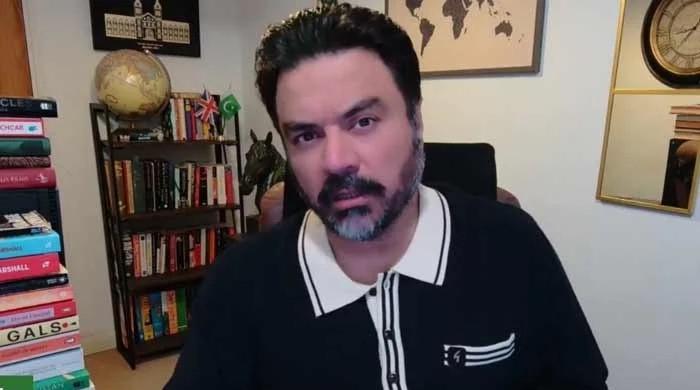

LONDON: Adil Raja has lost his appeal on all grounds at the UK Court of Appeal in the defamation case won originally by Brigadier (retd) Rashid Naseer at the London High Court on October 9 last year — with Lord Justice Warby ruling that the defamation case and its outcome has absolutely nothing to do with the state of Pakistan or last December’s attacks on Raja and Shahzad Akbar by an organised gang.
The court of appeal ruling by the senior judge Lord Justice Warby concludes the case absolutely in Naseer’s favour, ordering that Raja cannot seek a review or appeal against the decision anymore and must comply with the original court decision, which means that he will have to pay around £300,000 to Naseer in damages and legal costs.
Raja had appealed at the Court of Appeal against the October 2025 decision by Judge Richard Spearman KC, who had ruled that Raja defamed Naseer, without any factual basis or evidence, made false allegations, and therefore awarded £50,000 in damages to Naseer, and an injunction restraining Raja from repeating his baseless and false allegations ever again. The judge had also ordered Raja to publish a summary of the judgment confirming that Naseer had won the case and that the allegations were defamatory.
Raja had appealed against the judgment on four grounds, but also tried to argue his appeal was based on the “fresh evidence” related to attacks on him and Akbar by seven people who have been charged. The four grounds of appeal were (1) that the judge misdirected himself in law as to the requirements of the serious harm test; (2) that in doing so the judge had applied a presumption that Parliament had abolished; (3) the correct test required evidence that the publications had actually caused or were likely to cause serious harm; and (4) the judge had applied the wrong legal test and reversed the evidential burden.
In addition to seeking permission to appeal at the Court of Appeal, Raja also sought a stay of the High Court order so as to not pay Naseer, any damages or legal costs, and tried to introduce fresh evidence into the appeal, focusing on attacks on him and Akbar last December and linking it with Naseer’s case and the state of Pakistan, arguing that the attacks were linked with his decision to file an appeal against the original decision.
In his witness statement supporting his application to bring in fresh evidence, Raja relied on a number of matters. He said (1) he had published a video about Osama Bin Laden after the Judgment had come out as a result of which the Pakistani authorities had initiated a series of adverse actions against him; (2) that an extradition request had been made because of his journalistic work about the Pakistani military and state institutions; (3) that his witness Akbar was attacked in his home and suffered a broken nose and a fractured jaw; (4) that someone had entered and ransacked his home which he stated was because of his journalism and because he had filed an appeal; (5) that he was designated as a terrorist because of his journalism and because he had filed an appeal; and (6) he had been charged and convicted in Pakistan for his involvement in the May 9 unrest.
Both Shaheen Sehbai and Colonel(retd) Syed Akbar Hussain gave supporting statements setting out their personal woes in relation to their convictions by the Anti-Terrorism Court in Pakistan for their involvement in the May 9 unrest, which had nothing to do with publications sued upon.
Naseer’s lawyers opposed the application on the grounds that it was “abusive, incoherent and… frankly irrelevant to the substantive appeal”. They stated that there was “absolutely no evidence” linking Naseer to the attacks on Raja and Akbar, and there was no evidence that they were done in revenge because Raja had made an application for permission to appeal. They also noted that Raja had initially stated that Akbar, who was a witness in the defamation trial but stayed away from the appeal process, was going to give a supporting statement in the appeal which did not materialise.
At the Court of Appeal, Lord Justice Warby agreed with Naseer’s position.
Lord Justice Warby, in his order, wrote that he had carefully read the evidence “concerned with repressive actions said to have been taken by the Pakistani authorities towards the defendant and two others on and after 4 December 2025”. The judge continued, “That was after the date of filing of this appeal. But it by no means follows that it was because of the appeal, as the applicant maintains. Whilst the evidence asserts a causal link, it does not appear to me to contain any coherent and credible explanation of why that assertion is made.“
Lord Justice Warby found that “none of the four sub-grounds of appeal has a realistic prospect of success”. He also stated, “It does not appear to me (for instance) inherently likely that the authorities have, as suggested, convicted the applicant in his absence of terrorism because he launched this appeal. I have explained why I consider that the grounds of appeal lack arguable merit. The claimant/respondent has filed a statement to the same effect. There is nothing before me to indicate that the claimant or the Pakistani authorities felt threatened by the prospects of this appeal”.
Naseer started his defamation claim against Raja in August 2022 over ten publications — published between June 14 and 29, 2022, on Raja’s Twitter, YouTube, and Facebook. The court found that nine of these publications were seriously defamatory to Naseer and caused him serious harm.
The trial focused on the allegations made by Raja against Naseer; the state of media and politics in Pakistan, Arshad Sharif’s killing, the removal of Imran Khan’s government, ethical and responsible journalism, Pakistan’s establishment, and how Naseer became the focus of Raja’s social media campaign.
During the trial in July this year, Raja had pleaded defences of truth and public interest. To succeed on the truth defence, Raja had to show that the allegations he made were true or substantially true.
Naseer was represented by Barrister David Lemer of Doughty Street Chambers and Ushrat Sultana and Sadia Qureshi of Stone White Solicitors. Raja was represented by Barrister Simon Harding, instructed by Nasir Khan of Gunnercooke LLP.
Seven men have been charged with attacking Raja and Akbar around three months ago. They are Asaf Hussain Afsar, Mark Regan, Liam McGarry, Louis Regan, Clark McAulay, Doneto Brammer, and Karl Blackbird. They will go on trial in mid next year.
Discover more from Brackly News
Subscribe to get the latest posts sent to your email.