
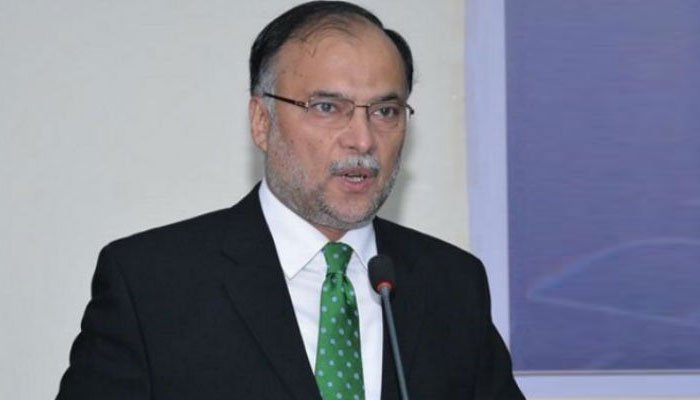
Federal Minister for Planning, Development and Special Initiatives Ahsan Iqbal on Saturday said Pakistan’s progress depended on peace, stability and continuity of policies, stressing that the country could not afford political disruption if it was to achieve long term economic targets.
Addressing a book launch ceremony at the Lahore Press Club, the minister said former prime minister Mian Muhammad Nawaz Sharif introduced development based politics in the country by focusing on economic growth, infrastructure and reform.
He said Nawaz Sharif gained public support due to his economic agenda aimed at development and prosperity, adding that most major development projects in Pakistan were launched during his tenures.
Ahsan Iqbal said Nawaz Sharif introduced key economic reforms in 1990 and 1991 after recognising the requirements of a modern economy. He said India later followed similar reforms and that former Indian prime minister Manmohan Singh had acknowledged that India benefited from them. He added that Pakistan’s failure to sustain those reforms led to instability.
He said had the reforms continued for 10 years, Nawaz Sharif would have been recognised internationally at a level higher than Malaysia’s Mahathir Mohamad.
Referring to Nawaz Sharif’s third term beginning in 2013, the minister said the country at that time was facing severe electricity shortages, terrorism and economic weakness. He said the government managed to address these challenges and that the China Pakistan Economic Corridor highlighted Pakistan as an emerging economy.
Ahsan Iqbal said the development process was halted in 2017 when the PML N government was removed through a conspiracy.
Highlighting infrastructure projects, he said Nawaz Sharif prioritised national connectivity by expanding the motorway and road network. He said travel time from Gilgit to Skardu was reduced to nearly three hours from 12 to 13 hours, while travel time on routes including Multan to Lahore, Sukkur to Multan and Gwadar to Quetta was also reduced. He added that roads and motorways in Karachi, Hyderabad and Balochistan improved connectivity.
He described Nawaz Sharif as the Sher Shah Suri of Pakistan for spreading a wide network of roads and motorways.
The minister said Nawaz Sharif faced repeated conspiracies and negative propaganda and remained the most scrutinised politician in the country’s history. He said cases such as the Iqama reference did not involve corruption allegations.
Calling Nawaz Sharif an architect of modern Pakistan, Ahsan Iqbal said there was a need for a Charter of Pakistan covering democracy, economy, society and security.
He said Pakistan’s armed forces had defeated the enemy in Marka i Haq but warned that attempts were continuing to destabilise the country through terrorism. He stressed that freedom of expression should be exercised responsibly and not misused for spreading false allegations, urging media organisations to develop a code of conduct.
The minister also congratulated the author, Muhammad Nawaz Raza, and appreciated his contribution to journalism.
Discover more from Brackly News
Subscribe to get the latest posts sent to your email.