
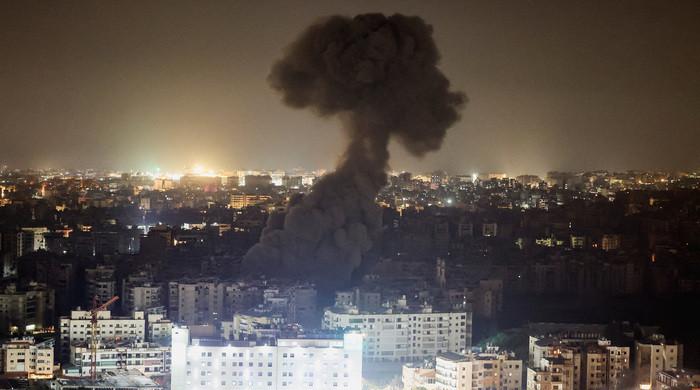

ISLAMABAD: Pakistan’s position in the ongoing conflict related to continuing attacks on Iran by the United States and Israel is anchored in international law, in norms of diplomacy, in non-use of force to settle dispute and in emphasis on dialogue and diplomacy The News reported.
It maintains that it is playing the role of a bridge builder, and its principled position on issues regarding sovereignty, international law and UN Charter and on dialogue and diplomacy is respected in all regional capitals, thus allowing it to exercise a channel of communication between the relevant capitals.
“Pakistan had condemned the unwarranted attacks against the Islamic Republic of Iran. These attacks come at a time when diplomatic efforts were underway to reach a peaceful and negotiated solution. Such a course of action will undermine the peace and stability of the entire region, with far reaching consequences,” said Tahir Andrabi, the Spokesperson at the Foreign Office during the weekly media briefing.
While condemning the attacks on Iran, Pakistan also condemns the attacks conducted from Iran against the brotherly Gulf countries. “So, our position is anchored in international law, in norms of diplomacy, in non-use of force to settle dispute and in emphasis on dialogue and diplomacy. This is the crux of our position. This is being communicated to our international interlocutors,” he said.
On the mediatory role of Pakistan in the continuing conflict, the spokesperson highlighted the three substantive thrust lines: respect sovereignty; uphold UN Charter and non-use of force; and move towards dialogue and diplomacy. “So, we would continue to urge all relevant parties to stick on these points. We have also undertaken a high-level exchange between relevant states. I have also mentioned our numerous telephone conversations and highest-level exchanges between our countries and relevant countries in the region,” he added.
Responding to a query on Iran allowing passage to oil tankers, oil ships carrying crude and oil, he said this is a matter between Iran and respective governments. “So, we do not have a particular position on this issue, particularly with respect to what transpired between Tehran and New Delhi,” he said.
Pakistan maintains an open channel of communication between Iran, Saudi Arabia and other Gulf countries. “Our deputy prime minister has spoken thrice with the Iranian foreign minister. The prime minister spoke, as I said yesterday, with President Pezeshkian. Now he is visiting Saudi Arabia. Yesterday, the deputy prime minister was in touch with Oman, and prior to that, with all Gulf countries. Two times he has talked with the deputy prime minister/foreign minister of the UAE, and at least once with all countries of the region; and this has been interspersed with his talks with Iranian counterpart. So, there is a level of exchange of communication,” said the spokesperson.
He acknowledged that he was aware of the conditionalities mentioned by Dr Pezeshkian in a tweet and Pakistan has taken note of it as an ongoing discourse.
“Everybody is aware of these conditionalities. So of course, when you talk on a situation, all issues are discussed. As regards in what precise way these issues are discussed, these are, you know, part of diplomatic exchanges, and frankly, I am not privy to any of those at this stage,” he responded to a query.
On whether there was any communication with Pakistan and Iran about whether they could do something potentially similar to be allowed to have Pakistan flagged tankers or tankers that are destined for Pakistan to travel through the Strait of Hormuz, the spokesperson said that this is directly linked to the naval operations conducted in the region.
“I believe that our defence and military (naval) authorities were in touch with the Iranian counterparts on this matter few days ago, which I can confirm. I cannot confirm or deny if any exchange took place between Pakistan and Iran today [Thursday] or yesterday [Wednesday]. At least I’m not aware of it,” he said.
Pakistan also strongly condemns the attacks by Iran against the brotherly countries of Saudi Arabia, Bahrain, Jordan, Kuwait, Qatar and the UAE, and stands in solidarity with all these brotherly countries and underscores the need to exercise maximum restraint. The unprovoked attacks constitute blatant violations of the sovereignty of brotherly Gulf states.
“Pakistan expresses serious concern over the recent attacks targeting the brotherly countries, Türkiye and Azerbaijan. These attacks are in clear violation of international law and the principles of inter-state relations and could push the region toward further escalation,” said the spokesperson.
Throughout the current wave of conflict, Pakistan has been urging respect for sovereignty and territorial integrity, along with a commitment to refrain from the use of force within each other’s sovereign territory. It has also called for upholding international law and the principles enshrined in the UN Charter, while emphasising the need to resume diplomatic engagement to pursue a peaceful, negotiated resolution to the crisis.
On reports that Iranian nationals arrived in Pakistan through Gwadar and Turbat borders, the spokesperson said that the question of spillover into Balochistan is a serious concern.
“I mean spillover of refugees and influx of miscreants remain a concern. I believe our security forces are on a heightened vigilance, and they would maintain that vigilance,” he said.
Commenting on the visit of the prime minister to Saudi Arabia, the spokesperson said that the visit is part of the coordination between Pakistan and Saudi Arabia on matters of regional peace and security and ending violence and hostilities.
“The prime minister’s visit should also be seen in the broader context of Pakistan’s efforts to advocate and facilitate an early cessation of hostilities and violence in region, with the aim of paving the way for dialogue and diplomacy,” he said.
On the situation in Afghanistan, the spokesperson said that the situation remains the same.
“We have emphatically communicated to Afghanistan and to our interlocutors – we need verifiable assurances from the Afghan side that their territory would not be used for terrorism against Pakistan. And since those assurances have not been received, so we will continue with our existing policy with respect to that country,” he said.
Pointing to the visit of Chinese special envoy, the FO spokesperson said that Pakistan maintains close coordination with China at all levels, including at the special envoys-level.
“Our Special Envoy Ambassador Sadiq is in touch with his Chinese counterpart. Ambassador Yue Xiaoyong is visiting Pakistan and I can confirm this news. We hope to have productive discussions with the Chinese side on our shared concerns, particularly on terrorism emanating from Afghanistan,” he added.
Originally published in The News
Discover more from Brackly News
Subscribe to get the latest posts sent to your email.