

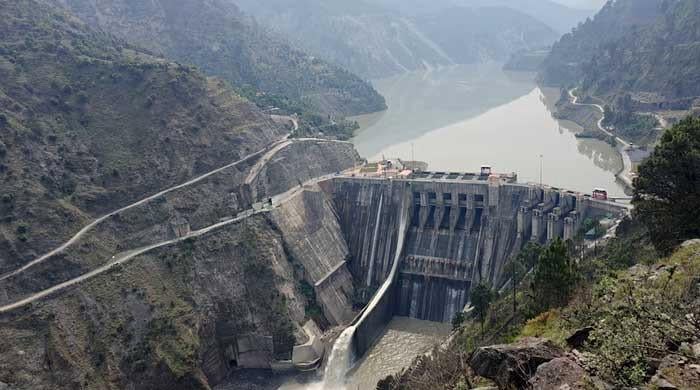

- India greenlights hydropower project on Chenab River in IIOJK.
- Sherry Rehman condemns India’s Chenab hydropower approval.
- IWT cannot be revoked unilaterally, says PPP Senator Rehman.
Pakistan Peoples Party (PPP ) leader Senator Sherry Rehman on Monday lashed out at India after New Delhi approved the Dulhasti Stage-II hydropower project on the Chenab River in the Indian Illegally Occupied Jammu and Kashmir (IIOJ&K), which is a flagrant violation of the Indus Waters Treaty (IWT).
Reacting to Indian media reports, the PPP leader said approval of the Dulhasti Stage-II hydropower project in IIOJK amounted to “weaponisation of water”.
“This weaponisation of water is neither sane nor acceptable in a region on the frontlines of climate change and environmental stress. It will inflame tensions in a bilateral relationship already bristling with hostility and distrust,” she said in a post on X.
Rehman said the IWT could not be unilaterally revoked and that recent United Nations rapporteurs had also reaffirmed the treaty’s validity.
“As per the IWT, which cannot be unilaterally revoked, as recent UN rapporteurs have confirmed, Pakistan has control over the waters of the Indus, Jhelum, and Chenab rivers, while the Ravi, Beas and Sutlej rivers fall under India’s control,” she said.
The PPP leader went on to say that under the treaty, Pakistan has rights over the waters of the Indus, Jhelum and Chenab rivers, while India controls the Ravi, Beas, Sutlej rivers and warned that any attempt to undermine the treaty would be unacceptable and could have serious regional implications.
As per the Indian media reports, India had approved the Dulhasti Stage-II hydropower project on the Chenab River in IIOJK.
The project would cost 3,277.45 crore Indian rupees, and work could be started on the disputed hydropower project early next year. The project will be developed by a public sector Indian company, NHPC Limited, The News reported on Sunday.
Sources have told the publication that the Dulhasti Stage-II project will generate up to 260 megawatts of electricity.
New Delhi’s decision is to be interpreted in the context of its decision to keep the IWT in abeyance following the Pahalgam incident, which led to the cross-border clashes between the two nuclear-armed neighbours after the former launched attacks inside Pakistan, prompting Islamabad to retaliate.
Despite India’s move, Pakistan has reaffirmed its commitment to the treaty, announcing that it will continue to fully participate in the Neutral Expert proceedings in good faith.
In August, the Permanent Court of Arbitration had declared India shall “let flow” the waters of the western rivers for Pakistan’s unrestricted use.
The waters of the Chenab River Basin have been shared between Pakistan and India under the 1960 IWT, but the Dulhasti Stage-II project has been transgressing the provisions of the treaty.
Under the IWT, Pakistan has control over the waters of the Indus, Jhelum, and Chenab rivers, while the Ravi, Beas and Sutlej rivers were under India’s control.
Meanwhile, the latest project on the Chenab River could be detrimental from a defence and strategic point of view for Pakistan. The Chenab River falls within Pakistan’s territory, and Dulhasti Stage-II construction would negate IWT, which India has declared as suspended by defying international agreements.
Dulhasti Stage-II will utilise the existing infrastructure of the Dulhasti Stage-I project. Notably, the 390 MW Dulhasti Stage-I is a run-of-the-river scheme that was commissioned in 2007. The project will utilise the existing dam, reservoir and power intake of Stage-I.
In this phase, water will be drawn from the Marusudar River, which will be brought to the Dulhasti Dam through the Pakal Dul project. The objective is to ensure additional power generation by making maximum use of available water resources.
What is IWT?
Pakistan and India, neighbours, disagree over the use of the water from rivers that flow downstream from India into the Indus River basin in Pakistan.
The use of the water is governed by the Indus Waters Treaty, which was mediated by the World Bank and signed by the neighbours in September 1960.
The agreement split the Indus and its tributaries between the two countries and regulated water sharing.
India was granted the use of water from three eastern rivers — Sutlej, Beas and Ravi — while Pakistan was granted most of the three western rivers — Indus, Jhelum and Chenab.
There is no provision in the treaty for either country to unilaterally suspend or terminate the pact, which has clear dispute resolution systems.
The countries have argued over and disputed several projects on the Indus and its tributaries for years.
Pakistan is heavily dependent on water from this river system for its hydropower and irrigation needs. Pakistan says India unfairly diverts water with the upstream construction of barrages and dams, a charge India denies.
Pakistan is concerned that India’s dams will cut flows on the river, which feeds 80% of its irrigated agriculture. It has asked for a neutral expert and then an arbitration court to intervene in two recent hydropower projects.
Discover more from Brackly News
Subscribe to get the latest posts sent to your email.